


Femto Lasik

Femtosecond or Bladeless LASIK
Femtosecond laser has revolutionized laser refractive surgery. It is a precise, cutting tool that can make corneal surgery accurate and safe. Two lasers are used in this procedure. It entails making a corneal flap with a femtosecond laser as a first step followed by excimer laser power correction below the flap as the next step.
It involves carving out a lenticule or disc in the middle of the cornea with a femtosecond laser and then removing this lenticule out through a laser-made keyhole incision.
Step by Step Procedure
How Femto Lasik Is Performed?
Step 1

Flap created using highly precise Femtosecond laser.
Step 2

Flap folded back exposing inner corneal tissue
Step 3

Excimer laser reshapes cornea & corrects refractive error
Step 4

Flap folded back to original position

Femtosecond or Bladeless LASIK
◉ Predictability of flap thickness is better with femto-flaps i.e., a 100 micron femto-flap will be 100 micron whereas there can be variations with a microkeratome flap
◉ Predictability of flap diameter is better with femto made flaps
◉ Corneal size and curvature plays an important role in success of blade flaps while femto-flaps are independent of these variables. A steep or flat cornea can pose difficulty in flap creation with microkeratome/blade.
◉ Femtosecond flap making is a safer procedure with fewer complications (buttonhole, incomplete flap) as compared to blade LASIK.
◉ Femtosecond laser makes a vertical cut at the edge of the flap as opposed to the sloping edge of the blade flap.
◉ This results in better flap alignment and healing.
◉ Complications of epithelial cells growing under the flap edge are lesser in a femto-flap.
◉ Chances of flap displacement are lesser as the flap sits better.
◉ Femto laser makes planar, uniform flaps.
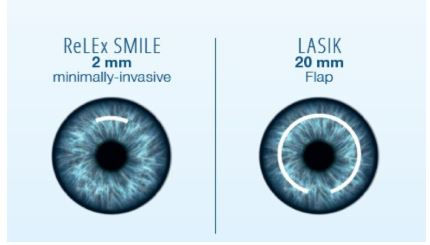
SMILE versus LASIK
◉ Flap complications like folds in the flap, displacement of the flap, buttonholes or complete cutting of the flap do not occur with SMILE
◉ The strength and structure of the cornea is preserved better with SMILE than with LASIK. The flap made in LASIK weakens the front of the cornea and cannot contribute to its strength in the future. A flapless procedure like SMILE is preferred for moderately high errors to provide better strength to the cornea in the longterm.
◉ Minimally invasive- 2 mm wound compared to 20 mm wound in LASIK. This results in more rapid recovery to routine activities
Procedure:
After the Procedure:
◉
Takes 20 minutes for both eyes together
◉
Numbing drops/ topical anesthesia used- no injection, no patch, no pain, no stitches, no blood
◉
One has to lie down for the duration of the procedure
◉
Eye is kept open and cannot be closed by the patient
◉
Two different laser machines are used
◉
Femto laser makes a flap in right followed by left eye
◉
Patient bed then moves to the next laser
◉
Excimer laser corrects power in the left and then right eye.
◉
Doctor’s instructions are to be followed during the procedure
◉
There is no pain or discomfort during the process
◉
Goggles are given
◉
Expect to see blurry and experience some watering, irritation on the day of treatment
◉
The day after, vision and comfort will be better
◉
Care to be taken while instilling drops to not disturb the flap
◉
No water in the eyes and head bath for 7-8 days
◉
Protective sunglasses outdoors for two weeks
◉
Side-effects: Dryness, glare, light sensitivity, night vision blurry These are common and gradually get better over a few weeks.
These are common and gradually get better over few weeks.
Do's And Dont's
Before Surgery
-
Stop wearing soft lenses 1 week before surgery
-
Stop wearing rigid gas permeable lenses 2/3 weeks before surger
Do's After Surgery
-
Use eye drops clean your eyelid margins
-
Plenty of rest
-
Watch TV & read books 1 day after Consume Healthy food
Dont's After Surgery
-
Don’t expose your eyes to dust/smoke
-
Don’t keep eyes open for too long
-
Don’t swim till your doctor approves
-
No touching/ rubbing eyes
-
No strenuous activity
-
Don’t drive on the day of surgery
Pros of Femto Lasik

Bladeless

Fast Recovery

Painless

Safer and more accurate than blade lasik

Can correct wide range of refractive errors (+ and -)

FDA approved
Frequently asked questions
There are different types of Lasik customisation that are available
01
Wave front optimised Lasik – Most Laser treatments that we use are wave front optimise that means our laser treatment does not add to the pre-existing aberrations of the eye.
02
Topoguided Treatment (Contura) - Topo Guided treatments are necessary for those with an irregular cornea either because of a decentred previous treatment or a corneal scar or a central Island. A topography guided treatment helps in regularising the irregular cornea for a better quality of vision and better up.
03
Ray Tracing ( Innova Eyes / Wavelight plus (InovEyes) / ivis Suite ) - A 3D model of the eye is constructed using ray tracing aberrometery this helps in customising the lasik treatment to each eye for better outcome.